
Guided play (also called guided play-based learning) sits between fully child-directed free play and direct adult instruction. Children retain leadership and agency in their play, while adults subtly scaffold the experience to support specific learning goals—such as literacy, math, science, executive function, or social skills.
This approach leverages children’s natural motivation and curiosity, often leading to stronger outcomes in cognitive, language, spatial, and problem-solving skills compared to free play alone or pure direct instruction.
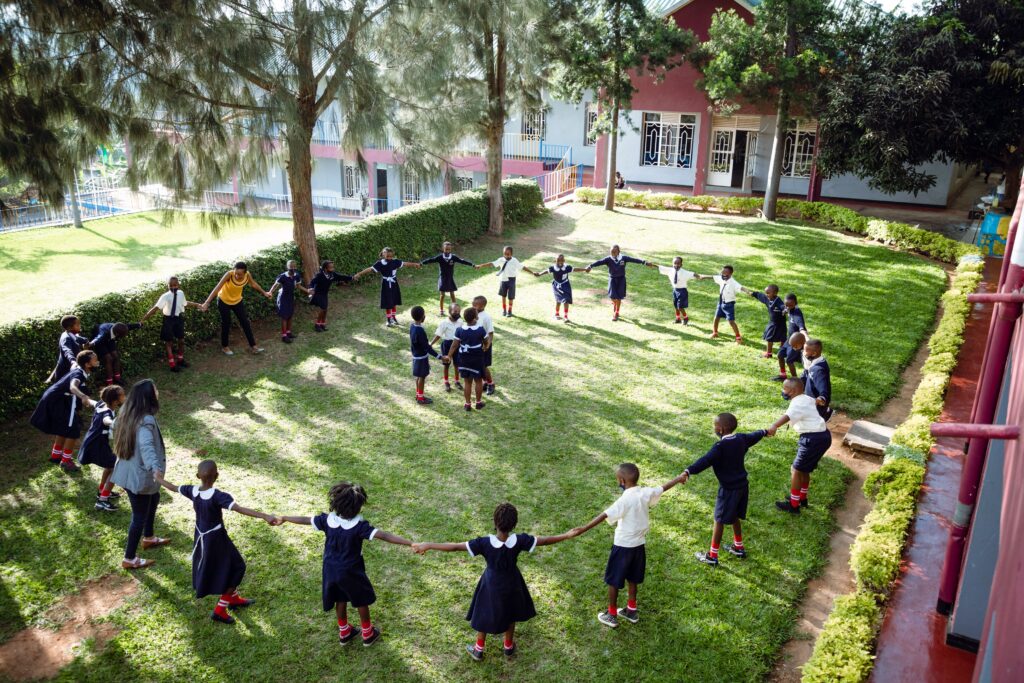
Core Principles of Guided Play
- Child agency first: Children choose how to engage and direct the flow.
- Adult scaffolding: Adults prepare the environment, observe, ask open-ended questions, make suggestions, or add materials without taking over.
- Intentional goals: Activities align with developmental or curricular objectives while remaining playful.
- Zone of Proximal Development (Vygotsky-inspired): Support is provided at the edge of what the child can do independently.
Guided play is particularly effective for building focus and executive function—key for all children, including those with ADHD—through enjoyable, low-pressure practice of attention, planning, flexibility, and self-regulation.
Two Main Forms of Guided Play
- Environment-based: Adults design or enhance the play setting with targeted materials to highlight learning goals, then step back while children explore freely within it.
- Interaction-based: Adults join ongoing child-led play, using questions, comments, or extensions to deepen thinking.
Practical Guided Play Strategies for Teachers and Parents
- Prepare the Environment Thoughtfully:
- Set up learning stations or “invitations to play” with open-ended materials tied to goals (e.g., blocks + pictures of bridges for engineering/spatial reasoning; colored mixing tools for science; letter-shaped manipulatives for literacy).
- Include loose parts (sticks, stones, fabric, recyclables) that encourage creativity.
- Observe and Document:
- Watch actively without interrupting initially. Note interests, challenges, and emerging skills.
- Use photos, notes, or videos to reflect and plan next steps. This informs future scaffolding.
- Use Open-Ended Questions and Prompts:
- “What do you think will happen if…?”
- “How could we make this taller/stronger/faster?”
- “Why do you think that happened?” or “What else could we try?”
- Avoid yes/no or directive questions that close down exploration.
- Join Play Sensitively:
- Follow the child’s lead. Narrate what you see (“You’re mixing the blue and yellow!”), model thinking, or extend ideas without directing the story.
- For dramatic play (e.g., pretend shop), participate in role and subtly introduce concepts like counting or sorting.
- Scaffold Gradually:
- Provide just enough support (hints, tools, or partnering) and fade it as competence grows.
- For group play, facilitate collaboration (e.g., “How can you two work together on this bridge?”).
- Incorporate Movement and Variety:
- Combine with physical play, music, or outdoor exploration.
- Use timers or signals for transitions if needed, especially for children with attention challenges.
Examples Across Domains
- Math/Numeracy: Blocks + number cards; pretend store with pricing and “money.”
- Literacy: Props for storytelling; magnetic letters in sensory bins.
- Science/STEM: Nature walks with collection bags and magnifiers; sink/float experiments in water tables.
- Social-Emotional: Role-play scenarios (doctor’s office, restaurant) to practice empathy and problem-solving.
- For Focus/ADHD Support: Short, engaging bursts with movement options, visual supports, and positive reinforcement during play.
Tips for Success and Common Pitfalls
- Start small and build: Balance with plenty of free play time.
- Respect child leadership — over-guiding turns it into direct instruction and reduces engagement.
- Differentiate: Adapt materials and support levels for individual needs (e.g., more structure for some, more freedom for others).
- Reflect and iterate: Regularly assess what’s working through observation.
- Partner with families: Share simple home strategies like guided block play or cooking together.
Research (including meta-analyses) shows guided play is highly effective for early learning outcomes, often outperforming other methods when goals are clear. It’s flexible for various ages (especially preschool to early elementary) and inclusive settings.
Guided play bridges joy and intentional learning. Experiment in your context, observe the children’s responses, and adjust. For specific age groups, subjects, or resources (e.g., lesson templates), let me know for more tailored ideas!